Terraform State Is a Data Product with a Security Boundary


10 min read
A platform can hide a password in a terminal and still distribute that password through its automation pipeline. The distinction matters when infrastructure outputs become inputs to developer portals, support tools, and AI assistants. Redaction protects one presentation. It does not automatically protect the underlying data or every subsequent representation.
Terraform state deserves to be treated as a governed data product. Its readers, copies, retention periods, and downstream transformations form an access boundary distinct from the permissions required to modify the infrastructure. The central design question is therefore broader than whether a value appears in a plan: which systems can recover it, and why do they need that capability?
The version used here predates the historical cutoff. HashiCorp's tagged documentation states that local state uses plaintext JSON and that state can contain sensitive resource attributes. It also distinguishes backend-dependent storage protection from runtime treatment. Those are established properties, not a newly announced March feature. Terraform 1.10.5 release, tagged state documentation.
Redaction is not removal
A sensitive input tells Terraform to limit its display in ordinary user-facing output. It does not make an ordinary persisted resource attribute disappear from state. The variable reference describes sensitive and ephemeral as different properties with different purposes. Treating them as synonyms creates a false sense of security. Version-pinned variable reference.
The difference becomes visible at a machine-readable boundary. The tagged show documentation explicitly warns that JSON output can expose sensitive values in plaintext. An automation step that converts a plan into JSON for analysis therefore needs its own handling policy, even when the human-readable plan looked appropriately redacted. Version-pinned show reference.
An AI integration is one possible consumer, but the issue is not specific to language models. A log collector, artifact browser or troubleshooting script can cross the same boundary. The security review must follow the data through the actual workflow rather than assigning one security classification to the command that produced it.
A complete local reproduction
The following configuration contains a synthetic canary with no external authority. It uses the built-in terraform_data resource, so no cloud provider or infrastructure account is required. The resource exists to make the value's lifecycle inspectable. Built-in resource documentation at the pinned tag.
terraform {
  required_version = "= 1.10.5"
}

variable "credential" {
  type      = string
  sensitive = true
  default   = "synthetic-canary-no-real-secret"
}

resource "terraform_data" "example" {
  input = var.credential
}

output "credential" {
  value     = terraform_data.example.output
  sensitive = true
}
The reproduction runs in an isolated local directory:
terraform init -input=false
terraform plan -input=false -out=review.tfplan
terraform show -json review.tfplan > review.json
terraform apply -input=false review.tfplan
terraform output -json > outputs.json
The executed study checked four observations. The ordinary plan did not print the canary. The saved-plan JSON contained it in the input-variable representation. The local state contained it after apply. The JSON output representation also contained it. These are measured results for this configuration and binary, not a claim that every provider stores every credential in the same location.
The example intentionally does not use a real password. Its purpose is to inspect propagation without creating an exposure. The directory itself is a synthetic laboratory artifact; replacing the canary with a production secret would change the risk without improving the demonstration.
A subtle point is that the resource's output can remain unknown during planning even though the supplied input value is already present elsewhere in the plan representation. Searching only the planned output field would miss that copy. A data inventory needs to account for inputs and configuration context as well as resolved outputs.
Follow the copies, not only the state backend
The first copy may be an environment variable in an execution worker. Another appears in a saved plan. A transformation creates JSON for a policy check. A troubleshooting step uploads that JSON to an artifact store. A summarizer then places selected fields in a model request.
Each transition creates a separate decision about necessity, access and retention. Encrypting one storage system does not decide whether the next service should receive the plaintext. Conversely, suppressing one log message does not eliminate the underlying artifact.
A proposed platform design classifies artifacts before export. Full plans and state remain in a restricted execution domain. A projection service produces a smaller review object containing only fields required by the downstream task. Access to that projection does not imply access to the original artifact.
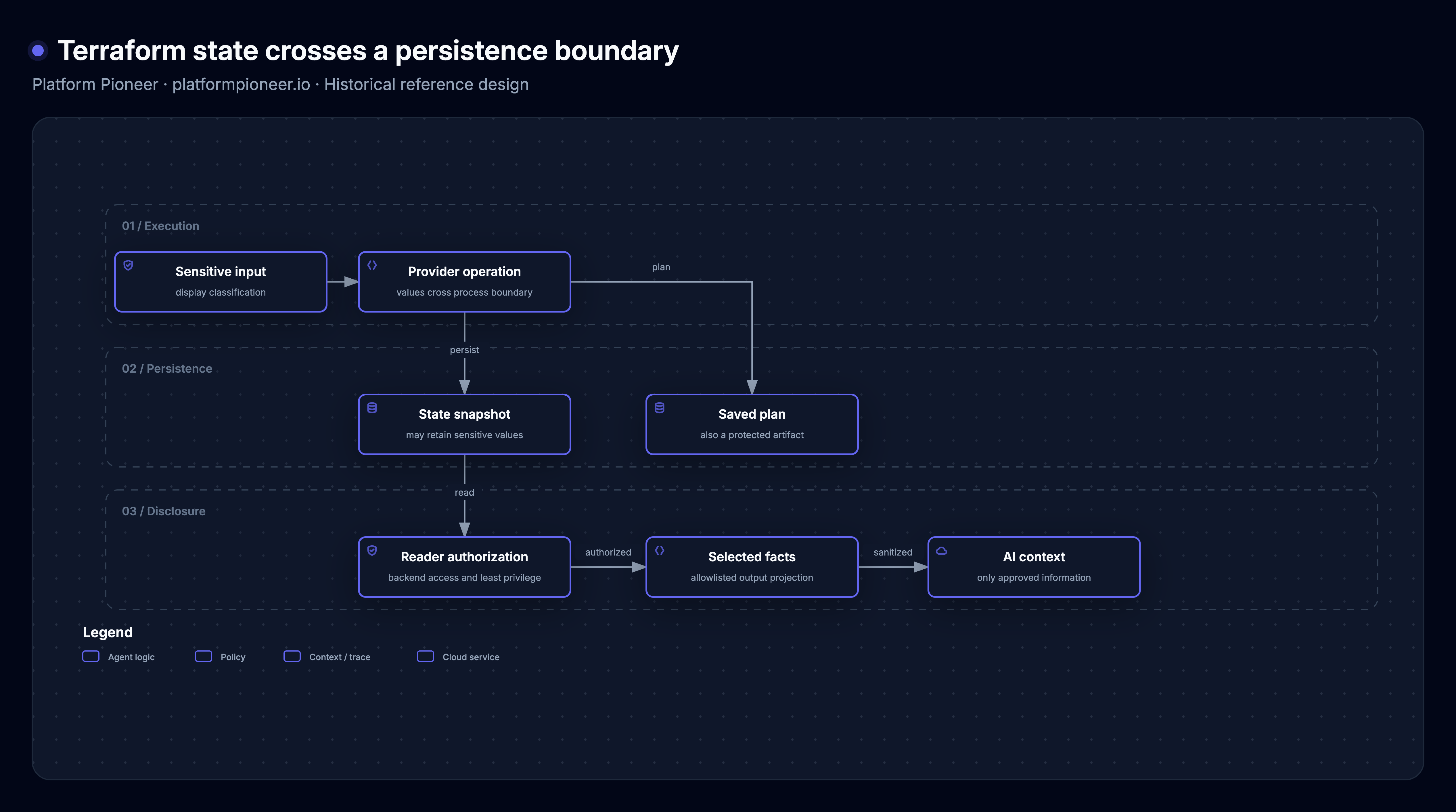
Reference design: the projection boundary is a platform responsibility, not an automatic Terraform security feature.
For an AI assistant explaining a change, a useful projection might include resource address, action category, ownership label and a reviewed description. It need not contain every before-and-after attribute. A richer troubleshooting task may justify additional fields, but that expansion should be explicit and bounded.
Projection requires a contract
Removing fields named password is not a sufficient projection strategy. Sensitive data can appear under application-specific names, inside nested structures or in a value whose sensitivity depends on context. A denylist is difficult to keep complete when providers and modules evolve.
An allowlist starts from the consumer's task. The projection schema can specify the permitted fields, types and size limits, then reject unexpected input shapes. The result is an architectural recommendation rather than a guarantee supplied by Terraform's sensitivity metadata.
The contract also needs a response to unknown values. A review interface should preserve the difference between absent, unknown and intentionally withheld data. Substituting an empty string for all three can make a partial explanation look complete and can lead an agent to propose changes based on invented certainty.
The projection service should retain a reference to the original run or artifact without embedding its content. That permits authorized investigation while keeping ordinary review traffic small. An opaque reference is useful only when dereferencing it requires an independent permission check; otherwise it merely relocates the access capability.
Separate infrastructure authority from information authority
A principal may need to propose a configuration change without reading the full state. Another principal may need diagnostic access without permission to apply. Combining those roles in one broadly privileged service identity increases the amount of authority exposed through every connected tool.
The proposed boundary assigns different identities to execution, artifact projection and conversational analysis. The execution worker manages the required Terraform artifacts. The projector reads an approved artifact and emits a constrained view. The assistant consumes that view and returns an explanation or proposed patch.
This separation does not prove that the implementation is secure. It makes the access relationships inspectable. An operator can ask whether the projector is authorized to read the artifact, whether the assistant can request a different projection, and whether any debugging path bypasses the intended schema.
Permission changes also need to cover existing copies. Removing a worker's backend access does not delete an already uploaded JSON file. A containment procedure must identify retained artifacts and downstream destinations, rather than treating credential revocation as retroactive data deletion.
Retention is part of correctness
Saved artifacts are useful for reproducing a review, investigating an incident and explaining a failed deployment. Keeping everything forever is not the only way to preserve those capabilities.
A retention design can keep decision metadata longer than sensitive payloads. For example, an approval record can retain artifact identity, configuration revision, checks performed and the selected outcome while the full plan has a shorter access-controlled lifetime. The exact periods depend on operational needs; no universal duration follows from this study.
Deletion must include derived copies. A plan removed from the primary artifact store may still exist in a build cache, support attachment or exported JSON file. The platform needs a map of expected destinations and a way to observe cleanup failures.
The trade-off is real: less retained detail can make later diagnosis harder. That cost should be evaluated against the sensitivity and reproducibility of the data. A structured, minimal decision record is often easier to preserve safely than an unbounded archive of execution output.
Ephemeral values are a different mechanism
Terraform 1.10 introduced ephemeral variables, outputs and resources, with restrictions on where ephemeral values can flow. The tagged state documentation describes their exclusion from state and plan files. That mechanism is relevant background, but this experiment does not exercise it or claim that every resource argument accepts ephemeral input. Version-pinned ephemeral discussion.
A platform still has to verify the complete consumption path. A temporary value may be appropriate for a provider authentication context while an ordinary resource argument requires persistence. The existence of an ephemeral feature does not establish compatibility for an arbitrary module.
Nor does non-persistence in Terraform prove non-disclosure elsewhere. A downstream process can log a value or transmit it to another service. Runtime handling and artifact storage are related controls with different enforcement points.
The practical consequence is to make the desired property explicit: suppress ordinary display, avoid Terraform persistence, restrict backend access, or minimize downstream disclosure. Each requirement needs a mechanism and a test that actually observes it.
Audit the reader, not only the writer
An infrastructure change log answers who requested a mutation. A state-access record answers who obtained information. Those are different events. A platform that records every apply but cannot explain a bulk state download has an incomplete account of its data exposure.
The proposed audit trail connects artifact creation, projection and retrieval through non-secret identifiers. It records the requesting principal, purpose, policy decision and destination category. It deliberately avoids copying the payload into the audit record, which would create another sensitive repository.
This design also needs failure behavior. If the projection service cannot establish the caller's scope or cannot parse an expected artifact version, returning the original plan as a fallback defeats its purpose. An explicit unavailable response preserves the boundary while giving the caller a reason to retry or escalate.
Authorization caching requires similar discipline. A cached projection can be convenient, but its accessibility should not outlive the permission model that governs it. Cache keys and invalidation rules need to distinguish users, workspaces and artifact revisions rather than treating a successful prior read as permanent authority.
These are implementation obligations for the surrounding platform. The local Terraform experiment establishes the need for the boundary; it does not exercise an audit backend or prove a particular caching strategy.
Failure-oriented validation
A useful acceptance suite checks the prohibited path, not only the intended output. The canary study can be extended to inspect exported artifacts, structured logs and the payload submitted to an analysis service. The claim under test should identify the destination and representation.
Failure injection is particularly valuable at schema changes. If a provider adds an unexpected nested attribute, the projection should reject or omit it according to a documented rule. A generic serializer that silently includes every new field expands disclosure without an explicit design decision.
The evidence store should also avoid retaining the very secret used to prove a leak. Synthetic canaries make that problem easier: they are identifiable without granting access to anything. Tests with real credentials need a much stronger justification and are unnecessary for this data-flow experiment.
No remote backend, hosted Terraform service or AI endpoint was exercised here. Those integrations need their own tests for authorization, transport, retention and error handling. The local result establishes the distinction between display redaction and stored or exported values, which is the narrow claim it was designed to examine.
A reliable developer platform makes that distinction visible in its architecture. Terraform state supports resource identity and execution; review projections support explanation. Giving each a deliberate data contract lets automation remain useful without turning every convenience feature into another reader of the full infrastructure record.