Agent Runtime Security Needs Evidence Beyond Credential Issuance


11 min read
A credential issuance record answers a narrow question: an identity obtained a capability from a credential service. It does not establish which tool consumed that capability, whether the resulting operation remained within delegated authority, or whether containment eventually stopped the relevant activity. For an AI platform, those are separate claims requiring separate evidence.
The architectural consequence is substantial. Agent security needs a platform-owned evidence contract across identity, credential delivery, tool execution, and target outcomes. A dashboard assembled from disconnected logs can describe activity while still being unable to explain who authorized a particular action. The missing element is a trustworthy relationship between records, not another summary of the agent's reasoning.
IBM's 12 November 2026 announcement connects its AuthMind acquisition with a broader Vault agent-security direction, covering registration, delegation, authorization, activity visibility and intervention. It also discusses deeper integration as work ahead. That announcement is context for this design, not evidence that the custom interfaces below ship as a particular Vault or AuthMind feature. IBM announcement.
The platform owns the relationship between identity and action.
Consider an agent assigned to investigate a failed deployment. The approved task permits reading one incident ticket and inspecting a bounded set of operational records. A model can propose useful tool calls, but the platform must determine which workload is making the request and which authority applies to it. A generated explanation cannot establish either fact.
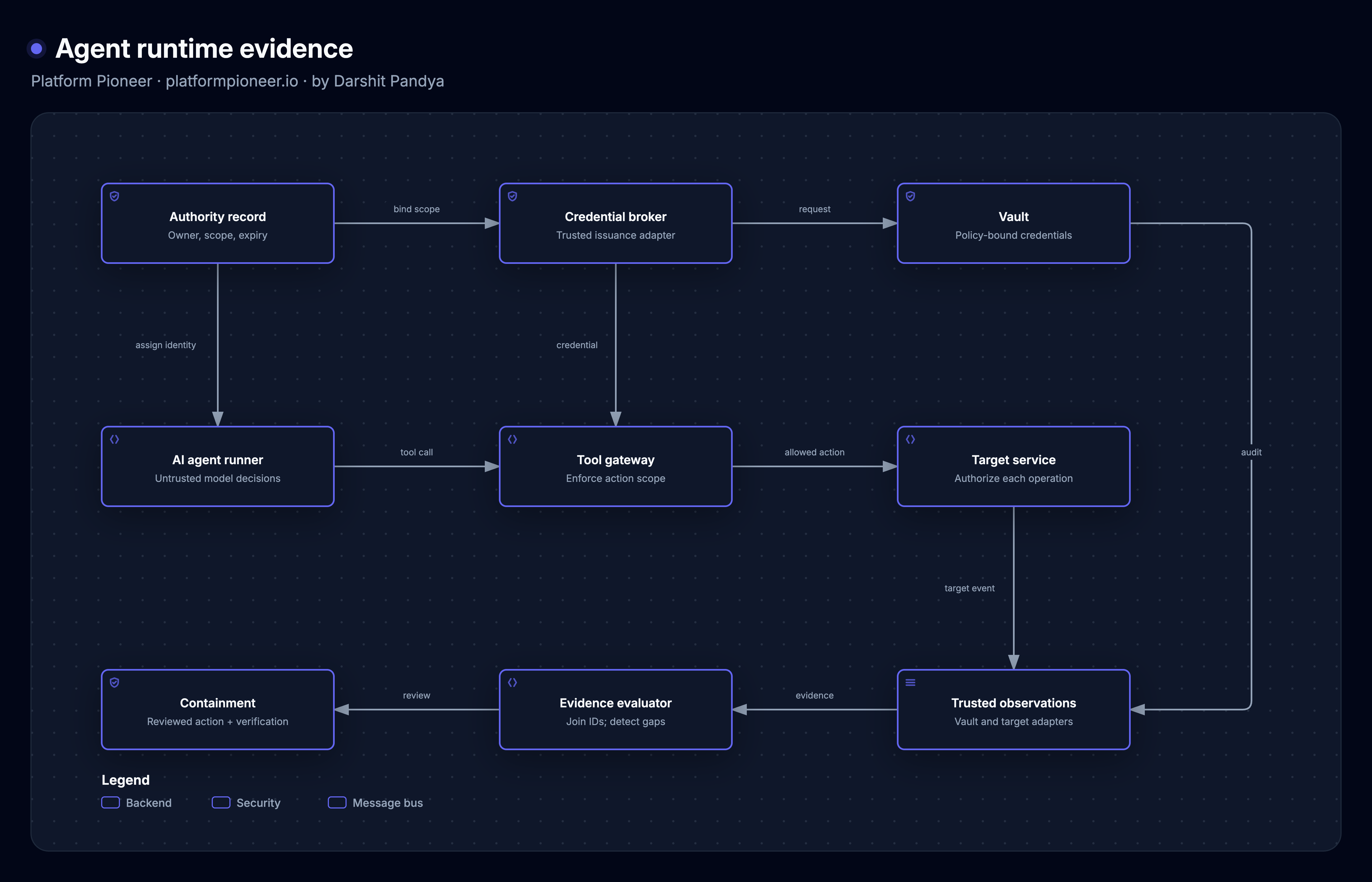
This reference design places a trusted adapter between the agent runner and its tools. The adapter obtains workload identity from the authenticated execution environment, resolves a versioned authority record, and evaluates each requested action before forwarding it. Tool arguments remain untrusted input. Credentials remain in the adapter where the integration permits, rather than becoming part of the model's context window.
The authority record includes an accountable owner, an agent instance, a run identifier, permitted resource selectors, allowed actions, and an expiry. Its identifier is immutable for that grant. Changing scope produces a new grant rather than silently rewriting the meaning of an existing audit trail. This is a proposed platform contract, not a Vault API schema.
Vault remains responsible for the credential boundary configured in its policies and secrets engines. Its audit devices record Vault API activity, with documented exceptions and handling of sensitive fields. They do not automatically provide an audit trail of every downstream operation performed with an issued credential. Target services and tool adapters must supply that evidence. Vault audit devices.
Correlation requires provenance, not just matching strings
Three records constitute the minimum useful chain for a single observed operation: the grant, credential issuance, and target action. The grant binds authority to a run. Issuance binds an opaque credential reference to that grant. The target event binds the observed operation to the same credential reference and workload identity.
The reference must be a platform-generated identifier rather than the credential itself. Storing a bearer token in an evidence lake would create an additional credential distribution path. A digest is not automatically a safe substitute either: its construction, access controls, and correlation lifetime need explicit design. A random broker-owned identifier can help prevent exposure of the underlying secret, provided the broker maintains the necessary protected mapping.
Vault's audit schema provides a request identifier that can be used to associate request and response entries. That identifier is useful inside the issuance adapter. It is not, by itself, an end-to-end trace identifier for a database query or HTTP action outside Vault. The adapter must deliberately carry the relationship across that boundary. Vault audit entry schema.
A target that logs only a shared database username may not support reliable per-run attribution. In that case, the platform has an evidence gap. Possible responses include narrower credential allocation, stronger target-side identity, or a gateway that mediates every supported action. Claiming precise attribution from an ambiguous shared identity would obscure the actual limitation.
Event producers also need authentication. An event containing source="target" is merely a statement unless the ingestion path verifies that producer. Signed messages or authenticated transport can establish provenance; schema validation and access controls then restrict the claims that producer may make. The example below assumes that work has already occurred. It cannot establish trust from JSON alone.
A small evidence reducer with explicit uncertainty
The following original Python example evaluates one synthetic operation. Integer timestamps represent a controlled test clock. Trusted adapters already normalize records; they are not raw Vault audit entries. The result is retrospective evidence classification, never permission to execute a tool call.
SOURCES = {"grant": "registry", "issue": "broker", "action": "target"}


def assess(events, now):
    seen, selected = set(), {}
    for event in events:
        if event["id"] in seen:
            return "REVIEW: duplicate event"
        seen.add(event["id"])
        kind = event["kind"]
        if kind not in SOURCES or event["source"] != SOURCES[kind]:
            return "REVIEW: unexpected source"
        if kind in selected:
            return "REVIEW: ambiguous evidence"
        selected[kind] = event
    if set(selected) != set(SOURCES):
        return "UNKNOWN: incomplete evidence"
    grant, issue, action = (selected[k] for k in SOURCES)
    if any(e["run"] != grant["run"] or e["agent"] != grant["agent"]
           for e in (issue, action)):
        return "REVIEW: identity mismatch"
    if issue["grant"] != grant["id"] or action["credential"] != issue["credential"]:
        return "REVIEW: broken reference"
    if not grant["at"] <= issue["at"] <= action["at"] <= now:
        return "REVIEW: chronology"
    if not (action["at"] < grant["until"] and action["at"] < issue["until"]):
        return "REVIEW: expired authority"
    if action["resource"] != grant["resource"] or action["verb"] not in grant["verbs"]:
        return "REVIEW: out of scope"
    if action["outcome"] != "success":
        return "REVIEW: target outcome"
    return "CONSISTENT: observed action only"


events = [
    dict(id="g1", kind="grant", source="registry", run="r1", agent="a1",
         at=100, until=200, resource="ticket/42", verbs=["read"]),
    dict(id="i1", kind="issue", source="broker", run="r1", agent="a1",
         at=110, until=180, grant="g1", credential="opaque-17"),
    dict(id="a1", kind="action", source="target", run="r1", agent="a1",
         at=120, resource="ticket/42", verb="read",
         credential="opaque-17", outcome="success"),
]
print(assess(events, now=130))
The successful result deliberately says “observed action only.” It does not certify the entire agent run. Fourteen local tests cover incomplete evidence, duplicates, unexpected producers, identity and credential mismatches, both expiry boundaries, impossible chronology, action scope, target failure, ambiguity and arrival-order independence. These are tests of the reference model, not an integration certification for Vault or AuthMind.
The reducer is intentionally strict about ambiguity. A production stream may deliver duplicates legitimately. Its ingestion layer would deduplicate identical records using authenticated producer identity and stable event IDs, while preserving conflicting duplicates for investigation. A run containing many actions also needs action-level grouping before this single-operation reducer is applied.
Missing fields, invalid types and malformed timestamps belong at a schema-validation boundary. Clock uncertainty requires a bounded tolerance policy, with ambiguous boundary cases retained for review. The compact example assumes validated inputs and a shared clock. Relaxing those assumptions without changing the classification rules would convert a clear experiment into misleading production code.
Enforcement and investigation have different timing requirements
Authorization must happen before a consequential action. Evidence correlation often happens afterward because independent systems deliver events at different speeds. Combining those paths carelessly creates two failure modes: granting access because no alarming log has arrived, or blocking all work whenever a reporting pipeline slows down.
The proposed design therefore separates a synchronous policy decision from asynchronous investigation. The tool gateway evaluates current authority against the requested operation. The evidence service later compares the recorded decision, issuance and target outcome. An absent target event remains unknown until the collection window closes; it is never translated into proof that nothing happened.
Collection windows need operational ownership. A five-minute correlation allowance might be reasonable for a low-risk reporting workflow and unacceptable for a privileged configuration change. The relevant number must come from measured producer latency and the consequence of delayed intervention. A universal timeout copied across tools would hide these differences.
The same separation improves developer experience. A denied call can explain the specific authority mismatch immediately. A later investigation can identify the missing producer or broken reference without exposing credentials. Platform teams can publish these reason codes through the internal developer portal so application teams can distinguish policy failures from telemetry failures.
Retries must not rewrite the evidence
An agent can retry a tool call after a timeout without knowing whether the target completed the first request. The evidence contract therefore distinguishes the logical operation from individual attempts. A stable operation identifier expresses intent; an attempt identifier records each transmission. Target-generated identifiers then connect attempts to actual outcomes. Collapsing all three into one generic trace field makes duplicate side effects difficult to investigate.
For a write-capable tool, the proposed adapter uses the target's documented idempotency mechanism where available. Where it is unavailable, a timeout becomes an uncertain outcome requiring reconciliation before another write. The evidence service cannot repair a duplicate external side effect after the fact. Its job is to preserve enough information for the orchestrator to make an informed recovery decision.
This also affects retention. The grant version and protected credential mapping must remain available long enough to interpret retained action records. Deleting the mapping earlier creates an apparently complete event history whose authority can no longer be reconstructed. Keeping everything indefinitely creates a different exposure. Retention should therefore follow a documented investigation window, with separate access policies for operational summaries and sensitive identity mappings.
The model-facing view can be much smaller than the investigator-facing record. A reason code, relevant resource identifier and approved remediation may be sufficient for an agent to stop or request assistance. Raw credentials, unrelated personal identity data and complete target responses do not belong in that view merely because they are available to the evidence service. This is a deliberate data-minimization boundary in the proposed platform.
Containment needs a bounded claim
A risky event should open a containment workflow with an explicit target: one credential, one agent run, one owner delegation, or a wider resource boundary. These are materially different scopes. A model-generated recommendation may help an operator understand the evidence, but the recommendation should not silently choose the maximum available revocation scope.
Vault supports lease renewal and revocation for applicable dynamically generated secrets. The downstream effect depends on the secrets engine and credential involved. A lease operation cannot establish that every target session, queued job or external side effect has ended. Each integration needs a documented verification method. Vault lease concepts.
This design records containment as requested, acknowledged and independently verified. Those states are deliberately separate. A successful control-plane response proves that a request was accepted at a particular boundary. Verification requires evidence from the affected execution path, such as a rejected subsequent request or a confirmed worker termination. The check must match the containment scope.
Absence of later events is weak evidence when the collector itself is unavailable. The workflow therefore also checks producer health and collection completeness. Where the target cannot expose a meaningful verification signal, the record remains qualified. An honest “containment acknowledged; target verification unavailable” is operationally more useful than a misleading green status.
An internal developer platform needs an evidence service level
The reusable platform capability is a contract for onboarding tools. Each adapter declares its identity source, authorization boundary, credential mapping, event schema, retention requirement and containment mechanism. The portal can then expose supported assurance levels instead of presenting every connector as equally observable.
A practical acceptance suite includes an allowed action, a denied action, an expired grant, a replayed event, a delayed target record and a lost producer. It also exercises credential replacement and owner reassignment so correlation survives ordinary lifecycle changes. These are proposed rollout criteria; the synthetic tests above cover only the reducer portion.
Useful operational measures include the fraction of observed actions attributable to an authority record, the age of unresolved evidence gaps, and the time from a containment request to a verified outcome. Raw log volume and credential issuance counts cannot substitute for those relationships. High activity can coexist with poor accountability.
AI adds another boundary: model reasoning is informative but is not an authoritative audit source. Prompts, retrieved documents and tool results can all contain untrusted content. Evidence extraction should use deterministic fields from authenticated systems; an AI summary should cite those records and preserve uncertainty rather than manufacture a coherent narrative across missing data.
The trade-off is integration work. Strong attribution may require new target instrumentation, separate identities or a mediation layer, each with latency and availability costs. That investment is best concentrated first on tools with consequential writes or sensitive reads. Read-only prototypes and production-changing agents do not need identical rollout gates, but their stated assurance must remain accurate.
Credential issuance is one event in an agent's operational life. The platform becomes accountable when it can explain the authority behind an observed action, identify the limits of that explanation, and verify the effect of an intervention. That is the engineering contract worth building around Vault and an AI execution platform.