A Developer Platform Needs an Application Contract, Not Just a Template


11 min read
Listen to this article
Matthew · Amazon Polly
A template can standardize the first deployment while leaving the platform unable to explain who owns the resulting application, which contract created it, or how changes should propagate to existing instances. The infrastructure may be consistent at creation time and fragmented a month later.
The missing element is an application contract: an explicit relationship among application identity, template identity, the underlying module, operational ownership, and the currently adopted revision. That relationship gives a platform something durable to govern after the form has been submitted.
HCP Waypoint supplies useful building blocks for that model. Its templates and add-ons became generally available on 15 October 2024, together with an application upgrade workflow and HCP API support. This study uses that established feature set within an evidence cutoff of 14 June 2026. It concerns hosted HCP Waypoint, not the earlier standalone Waypoint build-and-deploy project. GA announcement, product direction.
The proposed contract below is additional platform design. It does not assume that a portal automatically supplies an ownership database, approval protocol or atomic application migration.
Three identities that serve different purposes
An application name is useful to a person. A template identifier identifies a platform offering. An infrastructure workspace identifies an execution and state boundary. Treating these as interchangeable makes later operations ambiguous.
The historically pinned HCP provider schema illustrates part of the distinction. An application has a required name and template identifier, while its computed identifier is separate. Template resources identify their no-code module source and target Terraform project. Those fields existed in HCP provider 0.100.0, released in December 2024. Application schema, template schema.
The design inference is that a friendly name should not be the sole join key between operational systems. Renaming a service should not silently create a second ownership record or redirect a deployment to another workspace. A registry can retain a stable application identifier while treating its display name as mutable metadata.
Ownership also needs a precise meaning. The team that maintains a template may differ from the team operating an application created from it. The first owns the reusable implementation and migration guidance. The second owns the service's operating decisions and acceptance of a particular update. Both relationships belong in the contract.
Separate the offer from the adopted revision
A published template outlines a possible path. An application expresses an instance that adopted a particular path at a particular point.
The 2024 GA announcement describes template updates being rolled out to applications so their developers can upgrade. That establishes an upgrade capability; it does not justify treating every existing application as already migrated when the underlying module changes. Historical upgrade announcement.
A proposed registry therefore records two revisions: the currently offered contract and the revision adopted by the application. Their difference is useful operational information. It can identify applications eligible for an update without asserting that the update is safe for every workload.
A revision should cover the dimensions that affect the application's behavior. In this study, those dimensions are module source, module version, input schema revision, and ownership policy. Cosmetic documentation changes can have their own revision stream. Mixing every README correction with an infrastructure migration creates unnecessary operational noise.
The registry is not a second Terraform state file. It records evidence of relationships and governance, while Terraform remains responsible for its managed resource state. Duplicating resource internals in the portal would create another reconciliation problem without improving the contract.
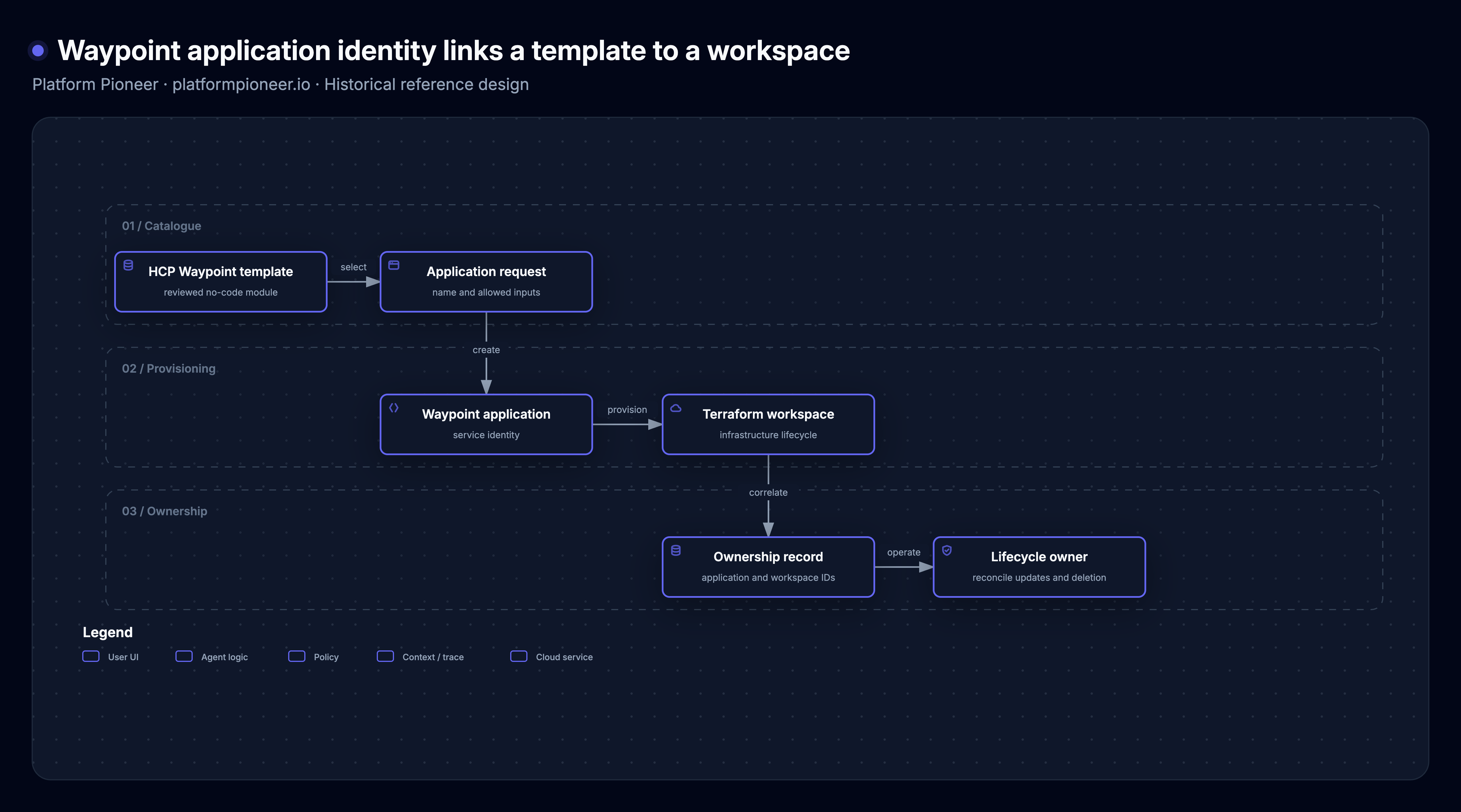
Reference design: the ownership and revision registry is an added platform component, not an undocumented HCP Waypoint service.
Make contract changes mechanically visible
A compact representation can make those relationships testable. The following complete local example uses synthetic identifiers and Python's standard library. Its fields are an original registry schema; they are not a request body for an HCP API.
from dataclasses import dataclass, replace
import hashlib
import json

@dataclass(frozen=True)
class Contract:
    template_id: str
    module_source: str
    module_version: str
    schema_revision: str
    owner_team: str

def fingerprint(contract):
    body = json.dumps(contract.__dict__, sort_keys=True, separators=(",", ":"))
    return hashlib.sha256(body.encode()).hexdigest()

def admission(application, contract, teams):
    if not application["id"] or not application["workspace_id"]:
        return "INCOMPLETE_IDENTITY"
    if application["owner_team"] not in teams:
        return "UNKNOWN_OWNER"
    if application["template_id"] != contract.template_id:
        return "WRONG_TEMPLATE"
    if application["adopted_contract"] != fingerprint(contract):
        return "UPDATE_REVIEW"
    return "CURRENT"

offer = Contract("tpl-17", "registry.example/platform/service",
                 "2.4.0", "schema-3", "platform")
app = dict(id="app-42", workspace_id="ws-17", owner_team="catalog",
           template_id="tpl-17", adopted_contract=fingerprint(offer))
teams = {"platform", "catalog"}
assert admission(app, offer, teams) == "CURRENT"
changed = replace(offer, schema_revision="schema-4")
assert admission(app, changed, teams) == "UPDATE_REVIEW"
print("Identity and adopted-revision checks passed")
The hash is a compact comparison value, not an authorization token. It says whether the recorded contract matches a candidate offer. It does not prove who approved either record or whether an infrastructure deployment succeeded.
The model deliberately refuses missing application or workspace identifiers before checking revision equality. Otherwise an incomplete inventory entry could appear current simply because its hash happened to match. It also checks the owning team against a known inventory rather than accepting any nonempty string.
The accompanying local study exercises changes to each contract dimension and several invalid identity cases. Its execution occurs when this historical article is prepared, not on the June archive date. No HCP account, remote workspace or actual application upgrade is involved.
Inputs should describe a product boundary
A template's inputs are part of its public interface. They should express decisions that the application owner is entitled and equipped to make.
An environment selector or capacity class can be a useful product decision. A raw cloud administrator role or arbitrary remote module source usually belongs to the platform implementation. Exposing every internal variable increases flexibility but transfers architectural decisions to a form that may not explain their consequences.
The pinned template schema contains variable options with a name, type, selectable options and an editability flag. This is evidence that input presentation and module implementation are separate concerns. It is not evidence that a UI constraint replaces validation in the underlying module or remote API. Pinned template variable schema.
An AI assistant consuming the same offering needs the same distinction. It may translate a request into an allowed environment and capacity class. It should not infer permission to supply hidden configuration merely because an underlying module accepts that variable.
The contract can record the input schema revision alongside the module version. A changed enum, removed field or new required value then becomes an explicit compatibility question. The reviewer can distinguish a module implementation update from a change to the developer-facing interface.
Ownership must survive reorganization
Teams change names, applications move and responsibilities split. A static owner label eventually becomes an unreliable routing mechanism unless it has a lifecycle.
The proposed registry uses a stable team identifier and records ownership transfers as events. A transfer identifies the previous owner, new owner, accepting authority and effective revision. The application identifier remains stable across that change.
This matters because operational notifications are only one use of ownership. The same relationship may control who can approve an upgrade, request deletion or receive cost attribution. Updating a display label without examining those consequences can create a service that appears transferred while its actual permissions remain with another group.
A useful transfer workflow checks that the incoming team can access the application, its Terraform workspace and the operational systems required to run it. It also identifies temporary access retained by the previous owner. These checks are proposed governance requirements, not native transfer guarantees.
The platform team still owns the reusable path. Moving an application between teams does not silently transfer responsibility for the shared module. Keeping those two ownership relationships separate reduces confusion when a defect affects many applications.
Upgrade readiness is more than version distance
A newer module version is a candidate, not a universal improvement for every instance. A contract revision can require a new input, replace a resource, change an output or alter an operational dependency.
An upgrade record should therefore include the proposed contract, application-specific inputs, expected changes and the acceptance conditions for that application. The same template release may be routine for one service and require a maintenance window for another.
A platform can classify updates into categories such as documentation-only, compatible implementation change and migration-required change. The classification is useful only if it is backed by evidence. A version number alone does not prove compatibility.
A staged approach can first evaluate representative applications and inspect their plans, then expand to a controlled cohort. The registry can show offered, evaluated, approved, applying and adopted as distinct states. The state named adopted should follow successful verification, not merely the start of an execution.
That separation also improves developer experience. An owner can see whether an update is available, why it matters and which action remains. A single “out of date” badge cannot distinguish a deliberate exception from an upgrade that failed halfway through.
Failure cases belong in the application model
A workspace can exist while application registration fails. An application record can survive after its infrastructure has been removed through another interface. A template can be deleted or changed while instances still depend on its historical contract.
These are reconciliation scenarios for the proposed registry. The service needs enough durable identity to inspect the known application and workspace without recreating either merely because a lookup was inconclusive.
The design should treat partial creation as a recoverable state. Recording an intended application identifier and correlation value before provisioning can support investigation. It does not create an exactly-once transaction across HCP services; that would require guarantees beyond this model.
Deletion deserves equally careful handling. Removing the catalogue entry should not automatically prove the underlying resources are gone. Conversely, deleting resources should not erase the ownership and audit record needed to explain the change.
A retained tombstone can preserve the application identity, last adopted contract, responsible team and deletion evidence without retaining secrets. Its retention period is an organizational choice. The important property is that the history remains interpretable after the live application disappears.
Reconciliation needs evidence freshness
An ownership view also needs to explain how recently its facts were observed. A contract fingerprint can remain unchanged while the linked workspace has been deleted, suspended or moved outside the intended operating boundary. Revision equality and operational existence answer different questions.
The proposed registry therefore stores observation time separately from adoption time. Adoption records a deliberate accepted contract. Observation records the latest successful inventory check. A failed lookup preserves the previous observation and adds an uncertainty state; it does not automatically assert deletion.
This distinction prevents a transient service failure from triggering a second provisioning request. The controller can stop new operations against an uncertain association while retaining the identifiers needed for reconciliation. That costs some availability during an outage but avoids turning incomplete visibility into an infrastructure mutation.
An AI-generated explanation can summarize these states without merging them. “Contract current, workspace verification overdue” is more useful than a confident healthy badge assembled from stale data. The operational decision remains tied to recorded evidence rather than the fluency of the explanation.
Keep the historical and operational boundaries explicit
The examples use a provider schema published before the June 2026 cutoff and the dated HCP Waypoint GA announcement. The pinned provider's generated documentation still contains an older beta banner; the later, dated GA announcement supplies the lifecycle status for templates and add-ons. That discrepancy is retained in the evidence notes rather than silently copied into the article.
The archived application and template schemas establish the product-facing identities used here. The registry adds its own workspace association as an explicit integration responsibility. A successful local comparison cannot establish that an HCP application and a remote workspace are correctly linked; that requires account-backed verification of the actual identifiers. Pinned application schema.
The operational trade-off is additional registry and reconciliation work. A small platform may initially keep the contract in a reviewed repository. A larger estate may need a dedicated service and event history. The data model should remain narrow enough that it complements the provisioning system instead of competing with it.
The resulting platform offering is more durable than a template form. It can explain which application exists, who operates it, what contract it adopted and what evidence is required to change it. That is the foundation for intelligent orchestration: an assistant can reason over a clear application model while execution and ownership remain accountable to explicit systems.